
Description
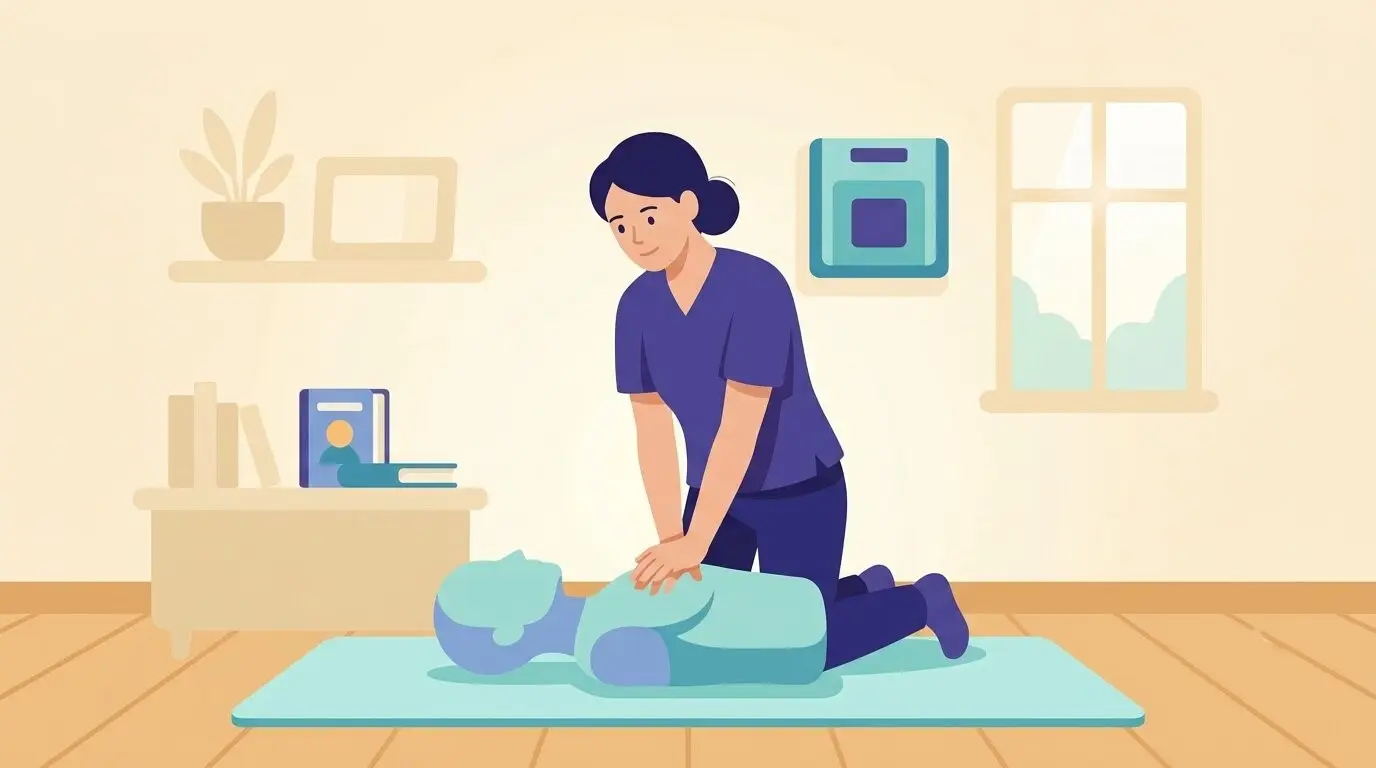
Care Certificate Standard 12 is the standard about basic life support, and it is the shortest requirement in the Care Certificate with the widest reach. It contains one outcome, 12.1, Provide basic life support, and the assessment against it is blunt: be able to carry out basic life support, and complete practical basic life support training that meets the UK Resuscitation Council guidelines. Everything else on this page exists to explain what that sentence asks of you, which group it applies to, and which part of it this course can and cannot satisfy.
The standards are published by Skills for Care, Skills for Health, NHS England and the Department of Health and Social Care. You can read the Care Certificate standards on the Skills for Care website, open the standards document itself, updated March 2025, or look at the Summary of changes Skills for Care published alongside it. The definitions quoted on this page are the glossary definitions from the standards document, and the outcome code is the code from that document. The guidance the standard names is published separately by the UK Resuscitation Council.
What This Course Covers
Standard 12 asks for competence, not awareness, and the distinction matters more here than in any other standard in the Care Certificate. There is no list of topics to read and no quiz to pass in place of a skill. The standard asks you to be able to carry out basic life support, and it asks for practical training that meets the UK Resuscitation Council guidelines. A certificate from a theory course is evidence that somebody read something. It is not evidence that you can do the thing.
So this course has one job and one boundary. The job is the knowledge that sits underneath the practical training: what the primary survey is and why it runs in the order it runs, how cardiopulmonary resuscitation differs between an adult, a child and an infant, what a choking casualty looks like and what you do about it, and what happens to the paperwork and the people involved once the ambulance has gone. The boundary is that the standard itself is not completed by this course. Your employer arranges the practical element, and you need it assessed against the Resuscitation Council guidelines to meet outcome 12.1.
That boundary is not a loophole, it is the design of the standard, and it is written into it. A course that claimed to complete Care Certificate Standard 12 on its own would be claiming something the standards document does not allow.
The content follows the outcome as it is written, so the course can be mapped against an induction checklist or an evidence folder without editing. The other standards sit in the same healthcare foundation course range. The standard before this one is Safeguarding Children, Care Certificate Standard 11, and the one after it is Health and Safety, Care Certificate Standard 13. Every Care Certificate course we run is listed together in the full course list.
Who It’s For
This course is written for the non-regulated workforce, which is how the standards document describes the people the Care Certificate was designed for. It names the roles in each setting, and in health roles these include assistant practitioner, care assistant, healthcare support worker, maternity support worker, nursing assistant, occupational therapy assistant, physiotherapy assistant, radiography assistant, speech and language therapy assistant, and senior care assistant. In adult social care they include activities worker, day care assistant, day care officer, domiciliary care worker, home care worker, nursing assistant in a nursing home or hospice, personal assistants, reablement assistant, residential care worker, senior home care worker, and support worker.
For this standard in particular, almost everybody who works in health or social care is in scope, because almost everybody will at some point be the person standing next to somebody who has stopped breathing. Adult care workers, home care workers on a round, reception staff, drivers, anybody working alone in a house, and people working in settings where the nearest colleague is a call away rather than a corridor away.
Two checks before you start. First, if you are a registered professional, such as a doctor, nurse, midwife or pharmacist, the standards document says you gain similar skills and knowledge within your professional training, so you do not need to also achieve the Care Certificate. Your professional body will still expect you to keep your resuscitation skills current on its own terms. Second, if your employer is running an induction that includes hands-on resuscitation training, this course is the knowledge half of that, and it is designed to be taken either side of it.
Provide Basic Life Support: The Standard in Full
This is the complete text of outcome 12.1, set out exactly as it appears in the standards document.
Outcome 12.1. Provide basic life support.
Be able to carry out basic life support. Complete practical basic life support training that meets the UK Resuscitation Council guidelines.
- If working with adults in health and social care they will undertake training in adult basic life support.
- If working with paediatric patients in health, they will undertake training in paediatric basic life support.
- If working with newborn patients in health, they will undertake training in newborn life support.
Guidance: most up to date Resuscitation Council Resuscitation Guidelines, and the Cardiopulmonary Resuscitation joint statement on standards for clinical practice and training.
Two things in that text carry more weight than the rest. The first is the word practical, which appears in the assessment line and not in the outcome line. The outcome is what you are able to do. The assessment is how it is evidenced, and the evidence is a practical course. The second is that the standard specifies guidelines rather than a named course or a named certificate provider. It names the UK Resuscitation Council, and it names it because the Council sets the clinical content that your practical training has to follow.
The Three Branches: Adults, Paediatric and Newborn
The three branches under outcome 12.1 are not three versions of the same course. They are three different populations, and the practical training you need depends on which one you will actually be faced with.
The adult branch is the one that catches the widest group of people. If you are working with adults in health and social care, this is the training you undertake, and it is the training most people will only ever need. It applies to home care workers, care assistants in residential homes, supported living staff, hospice workers, and anybody working with adults who may become unwell.
The paediatric branch applies if you are working with paediatric patients in health. A child is not a small adult. The physiology is different, the causes of arrest are different, and the technique in the guidelines differs from the adult sequence in ways that matter and that cannot be improvised by somebody who is good with adults.
The newborn branch applies if you are working with newborn patients in health, and it is a different discipline again. This is neonatal life support, it is taught to a different level, and it is not covered by adult basic life support or by paediatric basic life support. It is also the branch with the narrowest audience: it applies to people working in neonatal units, maternity units and special care baby units.
The wording of the standard is careful here, and it is worth reading it precisely. The adult branch says adults in health and social care. The paediatric and newborn branches say in health, not health and social care. The scope is not accidental, and if you are unsure which branch your role falls into, the answer is in your job description and in what your employer has booked you onto, not in this page.
Whatever branch you are in, one practical point holds across all three. Resuscitation skills decay. Guidance is revised, and the standard is written to point at the most up to date version rather than to a fixed set of steps, so a course you took several years ago may no longer match the guidelines your training is now assessed against. This is why the refresher point below matters.
Knowledge Is Not the Standard: The Practical Element
This is the part of the standard most often misread, and it is worth stating plainly. Completing the Care Certificate Standard 12 means doing two things: being able to carry out basic life support, and completing practical basic life support training that meets the UK Resuscitation Council guidelines. Reading about CPR, watching a video, or passing an online quiz does not close either of those.
What this course does is the first part of the preparation and none of the certification. It teaches the knowledge that sits under the practical training, so that when you go into that practical session you understand what you are being asked to do and why the sequence runs the way it does, and so that the knowledge component of your evidence is done and mapped.
What your employer does is the other part. They arrange the hands-on training, they book you with a trainer, and that training is assessed against the UK Resuscitation Council guidelines. The glossary for the standards uses the phrase agreed ways of working, which it defines as your employer’s policies, procedures and expected practices. The practical training you attend, the refresher interval that applies to you, and the certificate that goes in your folder are all things your employer sets.
The practical element also has consequences that people do not think about until it is too late. Practical resuscitation training is assessed. It is assessed by a trainer, in person, on a manikin or on a person, and being signed off on a chest compression depth and rate is a different claim from a certificate saying you completed a module. That is the point of it, and it is why the standard requires it rather than accepting a knowledge check.
One consequence worth planning for: if you work with adults in health and social care, you will also need to think about your own emergency arrangements, because the standard for the course you are reading sits next to a standard about health and safety. The glossary defines health and safety as something that “could be in relation to the safety of yourself, your colleagues or the people you support”, and the duty to the person in front of you and the duty to your own safety in that moment are the same duty.
The Guidance the Standard Points To
The standard names its guidance explicitly, and it is worth knowing both pieces by name because they are the documents your practical training will be measured against.
The first is the most up to date Resuscitation Council Resuscitation Guidelines. The wording matters. The standard does not point to a static set of steps printed in the Care Certificate, it points to the current version of the Council’s guidelines. When the guidelines are updated, the standard’s reference updates with them, and so does what your practical training is expected to teach. This is why an old certificate is not automatically a current certificate.
The second is the Cardiopulmonary Resuscitation joint statement on standards for clinical practice and training, which sets out what a course delivering CPR training should contain and how it should be delivered.
For a learner, the practical value of this is that there is a single source of truth and it is not your employer, your trainer or this website. If you and your trainer ever disagree about what the right sequence is, the Resuscitation Council guidelines settle it. For a course provider, it is that the content of the course has to track the guidelines as they are revised, which is why the phrase most up to date appears in the standard rather than a fixed edition number.
The glossary for the standards supports the same idea in a different key. Standards, in the glossary, “may include codes of conduct and practice, quality standards, regulations, where appropriate registration requirements for role and national occupational standards”. The Care Certificate is one of those frameworks, and the Resuscitation Council guidelines sit inside it as the clinical content that the Care Certificate points to.
What the Standard Does Not Print
It is worth being clear about something that surprises people. The Care Certificate standard for basic life support does not print the primary survey sequence. It does not print the compression rate, the depth, the ratio, the number of rescue breaths, or the order in which you do things. It does not print the signs of choking or what to do about them.
That is not a gap in the document, it is the design. The standard sets the competence, and it points outwards for the content, because resuscitation guidance changes as evidence changes and a printed standard would go out of date. The content lives in the Resuscitation Council guidelines, and your practical training is assessed against them.
So the sequence this course teaches, the primary survey sequence usually written as DRABCD, is not a Care Certificate sequence. It is the sequence your practical training is built on, and the reason it is taught here is that you cannot perform a sequence correctly if you do not know why it runs in that order. Every step in it exists because of something in the physiology of a person who has stopped breathing, and a learner who only memorises the letters will get them out of order under pressure.
Two other things the standard leaves to others. The first is the record-keeping after an incident. The glossary records that records “include written and electronic”, and your employer sets what the record is, who completes it and when. The second is the refresher. The glossary for the standards uses the phrase sources of support for “formal or informal support, supervision and appraisal”, and a refresher training slot is exactly the kind of support your manager arranges and your employer expects you to attend.
What the standard does fix, firmly, is that the guidance you are taught must be the current guidance, and that the practical training must meet it. Those two clauses are the whole of the standard’s content, and they are the two things that get checked.
What You’ll Learn
Across 6 structured lessons, this course covers:
- What basic life support is, and what this course does and does not cover (outcome 12.1). The difference between the competence the standard asks for and the knowledge this course delivers, and where the practical element sits.
- The primary survey for adults: DRABCD (outcome 12.1). The initial assessment of a casualty, why the sequence runs in the order it does, and what each step is protecting.
- CPR for adults (outcome 12.1). Chest compressions, rescue breaths and the sequence you are expected to perform, and how technique changes with the age of the casualty.
- Basic life support for infants and children (outcome 12.1). How the paediatric branch of the standard differs from the adult branch, and why the difference is not a matter of size alone.
- Recognising and responding to choking (outcome 12.1). The two kinds of choking, how to tell them apart, and what to do in each case.
- After an incident: record-keeping, confidentiality and refresher training (outcome 12.1). What happens once the ambulance has gone, the records your employer requires, and why the guidelines, and therefore your training, need refreshing.
Duration & Format
- Estimated time: 1.5 CPD hours
- Format: Fully online and self-paced: start, pause and return at any time
- Device: Desktop, tablet, or mobile
- Assessment: Knowledge-check quizzes throughout, plus a final assessment
Certification
On successful completion you receive a downloadable certificate confirming your achievement. It is mapped to Care Certificate Standard 12, and it counts for 1.5 CPD hours towards your continuing professional development record. It records completion of the knowledge component of the standard, and it is the practical training that completes it.
Common Questions
Does this course complete Care Certificate Standard 12?
No, and it would not be honest of it to say so. Outcome 12.1 requires two things: that you are able to carry out basic life support, and that you complete practical basic life support training meeting the UK Resuscitation Council guidelines. This course delivers the knowledge that sits under that practical training. The practical training is arranged by your employer and assessed against the guidelines. Put the two together and the standard is complete.
Which branch of the standard applies to me?
Three, and they are chosen by where you work rather than by choice. Adults in health and social care means adult basic life support. Paediatric patients in health means paediatric basic life support. Newborn patients in health means newborn life support. Note that the adult branch covers health and social care, while the paediatric and newborn branches are written for health. Your employer will tell you which you need, and the practical training you attend has to match it.
How often do I need to refresh?
Your employer and the current Resuscitation Council guidance set the interval, and both change, so this page will not quote a number that may be out of date. What the standard does do is point at the most up to date guidelines rather than a fixed edition, which means a training certificate from some years ago may not match the guidance your practical training is now assessed against. Check the current Resuscitation Council recommendation and your employer’s policy, and book the refresher before you are due rather than after.
Do I get a certificate?
Yes. Once you complete the course successfully, a downloadable certificate is issued to you, mapped to Care Certificate Standard 12 and worth 1.5 CPD hours towards your record. It covers the knowledge component of the standard, which your practical training then completes.
Which version of the standards does this cover?
The 2025 update, and this standard was one of the ones left alone. The Summary of changes published by Skills for Care alongside the March 2025 standards records, in full, that no changes have been made to Standard 12. It is one of only two standards in the document that the update left untouched, the other being Standard 11. This course follows the current version, and the outcome code on this page is the code from that document.
Is this course accredited?
This course is CPD-accredited and aligned to the Care Certificate framework published by Skills for Care, Skills for Health, NHS England, and the Department of Health and Social Care (updated 2025).
Care Pro Academy · Registered in the UK · Mundells, Welwyn Garden City, Hertfordshire AL7 1FT

Reviews
There are no reviews yet.