
Description
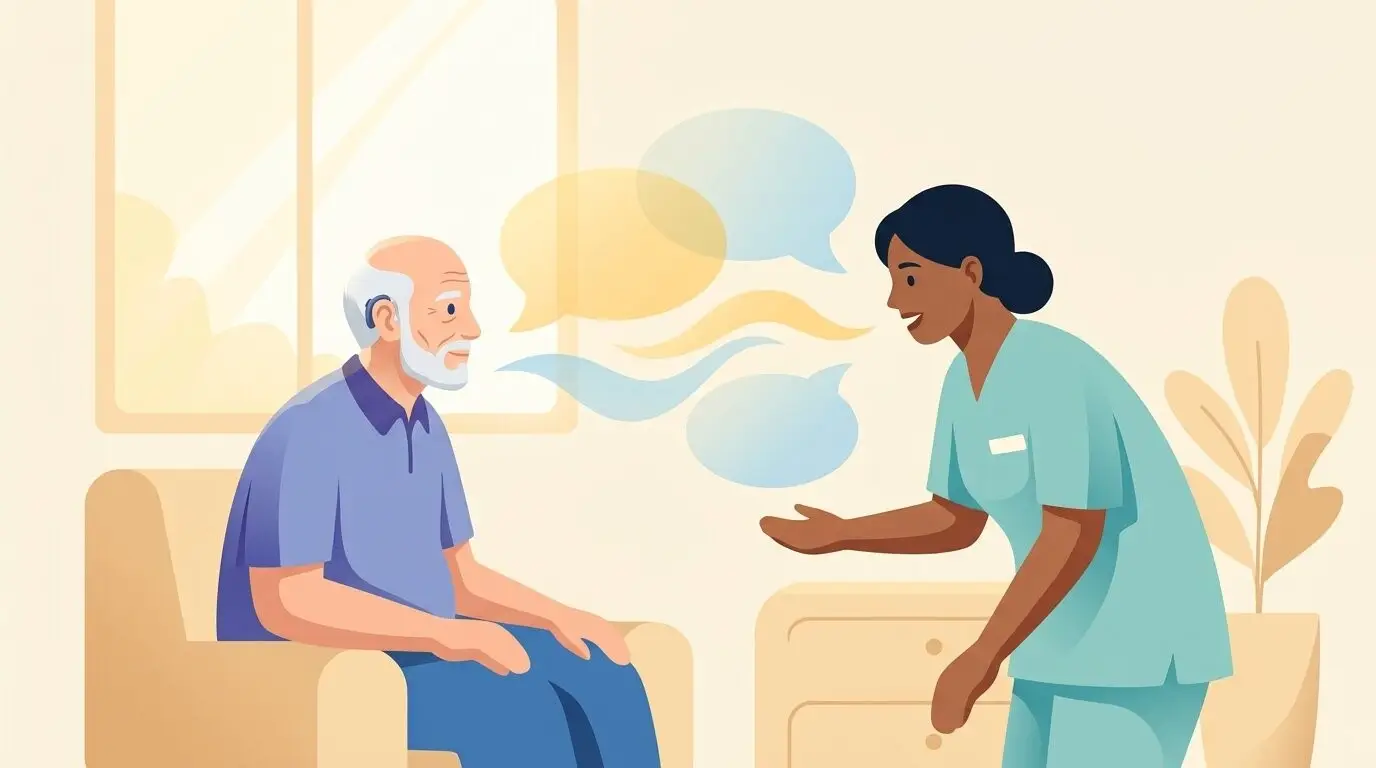
Care Certificate Standard 6 is the standard about how information actually gets between two people. It covers the range of ways people communicate, how to find out what an individual needs in order to be understood, the barriers that get in the way, why behaviour is itself a message, how to check you have been understood, what confidentiality means and where its limits sit, and how to use and support the aids and technologies some people rely on in order to communicate at all.
Standard 6 is one of the sixteen standards in the Care Certificate, and it runs to six outcomes. That puts it behind only Health and safety (Standard 13) and Work in a person-centred way (Standard 5) in length, and level with Privacy and dignity (Standard 7). Six outcomes sounds modest next to those two, but this is the standard the others quietly depend on. Almost nothing in a care plan works if the person cannot say what they want, or cannot be asked.
The standards are published by Skills for Care, Skills for Health, NHS England and the Department of Health and Social Care. You can read the Care Certificate standards on the Skills for Care website, open the standards document itself, updated March 2025, or look at the Summary of changes Skills for Care published alongside it. The definitions quoted on this page are the glossary definitions from the standards document, and the outcome codes are the codes from that document.
What This Course Covers
The six outcomes run in a deliberate order. The standard starts with why communication matters at work and how people communicate at all. It then moves to the individual: establishing what someone needs, wishes and prefers in order to be communicated with. After that come the obstacles, the idea that behaviour is a form of communication, and the basic skill of confirming you have been understood. Confidentiality comes next, because it governs what you are allowed to say in the first place. The final two outcomes are the practical mechanics: the verbal and non-verbal tools you use, and the aids, assistive technologies and digital communication tools you have to keep working.
The content follows those six outcomes exactly as they are written, so the course can be mapped to an induction checklist or an evidence folder without editing. The other standards sit in the same healthcare foundation course range. The standard before this one is Work in a Person-Centred Way, Care Certificate Standard 5, and the one after it is Privacy and Dignity, Care Certificate Standard 7. Every Care Certificate course we run is listed together in the full course list.
Who It’s For
This course is designed for healthcare assistants, support workers, domiciliary carers, care home staff, and agency workers starting or progressing in a health or social care role.
The standards document names the roles the Care Certificate is written for. In health roles these include assistant practitioner, care assistant, healthcare support worker, maternity support worker, nursing assistant, occupational therapy assistant, physiotherapy assistant, radiography assistant, speech and language therapy assistant, and senior care assistant. In adult social care they include activities worker, day care assistant, day care officer, domiciliary care worker, home care worker, nursing assistant in a nursing home or hospice, personal assistants, reablement assistant, residential care worker, senior home care worker, and support worker.
If you are a registered professional, such as a doctor, nurse, social worker or occupational therapist, you gain these skills and knowledge within your professional training, so you do not also need to achieve the Care Certificate. Some employers still ask registered staff to complete it as part of induction, so it is worth checking what your own employer requires.
One point about the scope of this standard is worth knowing before you start. The glossary defines work as something that “may include one specific location or a range of locations depending on your role”, and, importantly, that it “should encompass everyone you communicate with, not limited to; individuals, peers, team members, managers, friends, family and loved ones of the individual and paid workers and volunteers from other organisations and teams”. So this standard is not only about how you speak to the person you support. It covers the handover, the phone call to a family member, and the conversation with a colleague from another team.
Why Communication Matters
Outcome 6.1 asks you to understand the importance of effective communication at work. You have to describe the different ways that people communicate, and describe how communication affects relationships at work. Two asks in one outcome, but they are not the same claim. The first is descriptive: this is the range of what people do. The second is causal: this is what it does to the relationship you are trying to build.
The glossary defines communication more broadly than speech. It “includes using verbal and non-verbal communication such as signs, symbols, pictures, writing, objects of reference, human and technical aids, eye contact, body language and touch”, and it goes on to the method rather than the signal: communication “may take place using a variety of methods including verbal e.g. face to face, by telephone, written e.g., reports, records, by letter, and by using digital and virtual communication systems and platforms e.g. electronic care records systems, care monitoring systems via a computer, laptop, tablet or phone”.
That definition matters because it rules out a common assumption. Communication is not the same as talking. Someone who cannot speak is still communicating, and so are you, when you write the handover note instead of saying it aloud. A worker who treats communication as speech will work well with half the people they support and badly with the rest.
Outcome 6.1b is the part that makes this a care standard rather than a communications course. How communication affects relationships at work: it is the difference between a person who feels informed and one who feels managed, between a colleague who brings you a concern and one who keeps it to themselves, and between a family member who trusts you with a worry and one who repeats it to their neighbour instead. None of that appears in a care plan. All of it is decided by how you communicate.
Meeting Individual Communication Needs
Outcome 6.2 asks you to understand how to meet the communication and language needs, wishes and preferences of individuals. It divides into establishing them, and then responding to them.
Outcome 6.2a is about how you find out. The glossary is clear about what you are looking for: assessed needs “can include a variety of physical, mental health, emotional, social, spiritual, communication, learning, support or care needs”. Communication sits in that list as one need among many, not as a special case bolted on afterwards. In practice it means asking, and then writing it down, so the next worker on shift does not have to start from scratch. A communication need that lives only in one person’s head is not a need that has been met.
Outcome 6.2b asks you to list a range of communication methods, aids, assistive technologies and digital communication tools that could help meet an individual’s communication needs, wishes and preferences. Four categories, and they are not interchangeable.
Methods are the broad ways you communicate: face to face, telephone, written, digital. The glossary lists what digital communication skills can mean, and they “could include use of virtual communications platforms e.g., a PC, tablet, telephone/text, smart phone/watch and encompass a range of technical platforms such as using online services, monitoring platforms, forums, video calling, email, social media and chatbots”.
Communication aids are, in the glossary’s words, “aids which can support individuals to communicate in a way they understand”, and the list it gives is “signs, symbols and pictures, objects of reference, communication boards, makaton, British Sign Language, hearing aids, glasses, and braille”.
Assistive technologies are the powered and electronic end of that range. They “support, assist, and enable the individual to communicate using alternative means” and “could include a range of software such as: light writers, eye gaze devices, voice recognition, speech synthesizers, symbol making software”. The glossary widens the definition beyond the individual, noting that other technologies which could also support the individual and others could be considered here, for example “alerting devices, virtual assistants, sensors, hearing loops and artificial intelligence”.
Skills for Care’s Summary of changes records that the 2025 update added “aids, assistive technologies and digital communication tools” to this outcome, where the previous version asked only for a range of communication methods and styles. That is a short line in a table and a large change in practice: the list of things you now have to know about has grown well beyond talking and listening.
Barriers, Behaviour and Checking Understanding
Outcome 6.3 asks you to understand how to promote effective communication, and it has four parts: barriers, behaviour, checking understanding, and where to find help.
Outcome 6.3a asks you to list barriers to effective communication with individuals and how they can be reduced. The glossary names them: barriers “can include barriers of culture, gender, religion, language, literacy, health issues, disability, sensory or physical impairment”. Notice how many of those are not fixed. A barrier of culture is reduced by your own practice. A barrier of language is reduced by an interpreter. A barrier of literacy is reduced by reading it to someone rather than handing it over. A barrier of sensory impairment is reduced by a hearing loop that works. Only some barriers belong to the person. Most of them belong to what you have arranged.
Outcome 6.3b is the part the 2025 update added, and it is worth reading twice: describe how an individual’s behaviour may be a form of communication. People who cannot use words still send messages. A person who turns away, who calls out at night, who refuses a meal, who grips your sleeve, may be telling you they are in pain, that they are frightened, that they want to go home, or that the light is too bright. If you read behaviour as behaviour, you will miss the message. The glossary already points this way about needs: they include communication needs, and a person whose communication need goes unmet will show you through the only channel left to them.
Outcome 6.3c is the skill people skip and then fail an assessment on: describe how to check whether they have been understood. Not whether you were clear, and not whether they nodded. Ask. Offer a choice back to them. Watch whether what they do next matches what you said. Because the glossary definition of communication includes eye contact, body language and touch, the check happens on both sides: if their reaction does not match your words, one of the two is not doing what you think it is.
Outcome 6.3d asks where to find information and support or services to help the individual communicate more effectively. The glossary is specific about what services means here: “services may include translation, interpreting, occupational and speech and language therapy and advocacy services”. Sources of support “may include formal or informal support, supervision and appraisal”, and advice and support “can come from within or outside of your organisation and may include raising any concerns you may have through the most appropriate channels”. That last phrase is the practical one. Knowing who to ask is part of the outcome, not an optional extra bolted on to it.
Confidentiality
Outcome 6.4 asks you to understand the principles and practices relating to confidentiality. It has four parts, and they run in order: what it means for your role, the legislation and agreed ways of working behind it, the situations where normally confidential information might need to be passed on, and who you ask for advice.
Outcome 6.4b asks you to list any legislation and agreed ways of working to maintain confidentiality in day-to-day communication. The glossary defines legislation as “important legislation, which relates to topic content e.g., The Equality Act, The Human Rights Act, The Data Protection Act, and The Mental Capacity Act”. It defines agreed ways of working as “employers policies, procedures and expected practices”, adding that these “include those less formally documented by individual employers and the self-employed or formal policies”.
That second definition is the one people find hardest. The unwritten rules of a team are agreed ways of working too. If the household says the family never hears about the medication round before it happens, that is a policy, and breaking it breaks confidentiality even though nothing is written down.
Outcome 6.4c is where new workers panic, and it should not be a panic point. There are situations where information normally considered to be confidential might need to be passed on. They are not exceptions to a rule. They are the rule. And if you are unsure whether something falls into that category, that is precisely what outcome 6.4d is for: describe who they should ask for advice and support about confidentiality. The glossary makes the channel explicit, since advice and support “can come from within or outside of your organisation”, and it defines reporting as something done “in line with agreed ways of working” that “may include verbal, written and electronic methods”.
Verbal and Non-Verbal Communication
Outcome 6.5 asks you to use appropriate verbal and non-verbal communication, and it carries the longest checklist in the standard. Criterion 6.5a asks you to demonstrate the use of appropriate verbal and non-verbal communication, and it divides into four groups.
Verbal is tone and volume. Not the words alone. The same sentence at the same speed can be reassurance in one tone and impatience in another.
Non-verbal is position and proximity, eye contact, body language, touch, writing and signing. Each of these is a decision, and each can be made badly with good intentions. Standing over someone seated does something different from crouching down beside them. Reaching for a hand without asking does something different from waiting. And for some people, sustained eye contact is uncomfortable or frightening rather than respectful.
Communication aids are the third group: signs, symbols and pictures, and objects of reference. An object of reference is the real thing, brought in to stand for the idea of it, and it works for people who find an abstract conversation harder than a concrete one.
Channels are the fourth: face to face, by telephone or text, by written reports or letters, and by using digital tools and technology, for example email, internet or social networks. The standard names social networks deliberately, because that is where a lot of communication with younger service users now happens, and because it needs agreed rules rather than improvisation.
Criterion 6.5b adds the part that turns a list into an outcome: describe why it is important to observe and be receptive to an individual’s reactions when communicating with them. You are watching for the moment where what you meant and what they received come apart. That is the moment to slow down, change the words, or check again.
Communication Aids and Technology
Outcome 6.6 asks you to support the use of appropriate communication aids and technologies. The 2025 update changed its wording, and the change is worth noticing: it now asks you to ensure the appropriate and safe use of communication aids, assistive technologies, and digital communication tools, where the previous version referred only to communication aids and technology.
Criterion 6.6a sets out what appropriate and safe use means in practice. It has to be available. It has to be clean. It has to be working properly, including updated software where appropriate. And it has to be in good repair. Those four conditions are unglamorous, and they are the difference between a communication aid that supports someone and one that fails them at the moment they need it most.
Updated software is called out separately because a device that powers on is not the same as a device that is up to date. A symbol board whose software is two versions behind may still be missing the symbols this person uses. A hearing loop that needs servicing will fail at precisely the moment a relative is talking.
Criterion 6.6b asks you to report any concerns about the communication aid, technology or digital communication tool to the appropriate person, and it names who that might be: a senior member of staff, a carer, or a family member. Reporting in the glossary includes “the recording of adverse events, incidents, confrontations, errors and issues”, so a report is not only a word to somebody in passing. It goes into the record.
There is a balance to hold here, and the glossary names it. Risk averse means “balancing safety measures with the benefits individuals can gain from accessing and using technology, such as on-line systems, and the individuals rights to make informed decisions”. Someone who has a video call with a relative every week should not lose it because you are nervous. Someone who is being shown private images by another service user should not be left to it. The outcome asks you to support the use of aids, not to withhold them.
What You’ll Learn
Across 5 structured lessons, this course covers:
- Why communication matters, and how people communicate (outcome 6.1). Describe the different ways that people communicate, and describe how communication affects relationships at work.
- Understanding individual communication needs (outcome 6.2). Describe how to establish an individual’s communication and language needs, wishes and preferences, and list a range of communication methods, aids, assistive technologies and digital communication tools that could help meet them.
- Barriers, behaviour as communication, and checking understanding (outcome 6.3). List barriers to effective communication with individuals and how they can be reduced, describe how an individual’s behaviour may be a form of communication, describe how to check whether you have been understood, and describe where to find information and support or services to help the individual communicate more effectively.
- Confidentiality (outcome 6.4). Describe what confidentiality means in relation to your role, list the legislation and agreed ways of working that maintain it in day-to-day communication, describe situations where normally confidential information might need to be passed on, and describe who to ask for advice and support.
- Verbal and non-verbal communication, and supporting communication aids (outcomes 6.5 and 6.6). Demonstrate appropriate verbal and non-verbal communication across tone, volume, position and proximity, eye contact, body language, touch, writing and signing, explain why you observe and are receptive to an individual’s reactions, ensure communication aids, assistive technologies and digital communication tools are available, clean, working properly and in good repair, and report any concerns about them.
Duration & Format
- Estimated time: 1.5 CPD hours
- Format: Fully online and self-paced: start, pause and return at any time
- Device: Desktop, tablet, or mobile
- Assessment: Knowledge-check quizzes throughout, plus a final assessment
Certification
On successful completion, you’ll receive a downloadable certificate confirming your achievement. Your certificate is mapped to Care Certificate Standard 6 and contributes 1.5 CPD hours to your continuing professional development record.
Common Questions
How long do I have to complete this course?
There is no time limit. The course is entirely self-paced, so you can start, pause and return at any time from any device. If you are mapping it against an induction checklist, the outcome codes 6.1 to 6.6 on this page match the codes your assessor or manager will be looking for.
Do I get a certificate?
Yes. On successful completion you will receive a downloadable certificate confirming your achievement, mapped to Care Certificate Standard 6 and counting towards your CPD record.
What counts as a communication aid?
The glossary describes communication aids as “aids which can support individuals to communicate in a way they understand”, and it lists signs, symbols and pictures, objects of reference, communication boards, makaton, British Sign Language, hearing aids, glasses, and braille. That list is not exhaustive, and it does not need to be. What matters is whether it helps that person communicate in a way they understand.
Is an assistive technology different from a communication aid?
The glossary defines them separately. Communication aids are “aids which can support individuals to communicate in a way they understand”. Assistive technologies “support, assist, and enable the individual to communicate using alternative means”, and could include software such as light writers, eye gaze devices, voice recognition and speech synthesizers. In practice you may be supporting both at once, and outcome 6.6 expects you to know what each one is and what condition it needs to be in.
What does behaviour as communication mean in practice?
It means reading what someone does as a message rather than as a problem to be managed. The wording was added to outcome 6.3 in the 2025 update. If someone who cannot speak becomes distressed, calls out, or goes quiet at a particular time of day, that pattern is information. The action is to work out what the message is and to change what you are able to change, rather than waiting to be told.
Is this course accredited?
This course is CPD-accredited and aligned to the Care Certificate framework published by Skills for Care, Skills for Health, NHS England, and the Department of Health and Social Care (updated 2025).
Which version of the standards does this cover?
The 2025 update. The title of this standard did not change, and it still covers communication across six outcomes. The Summary of changes Skills for Care published alongside the standards records what moved within it: aids, assistive technologies and digital communication tools were added to outcome 6.2, outcome 6.3 added describe how an individual’s behaviour may be a form of communication, and outcome 6.6 was extended to ensure the appropriate and safe use of communication aids, assistive technologies, and digital communication tools, in place of communication aids and technology alone. Skills for Care also recommends a thorough review of this standard so that development with the use of digital approaches and technology is integrated. This course follows the current version, and the outcome codes on this page are the codes from that document.
Care Pro Academy · Registered in the UK · Mundells, Welwyn Garden City, Hertfordshire AL7 1FT

Reviews
There are no reviews yet.