
Description
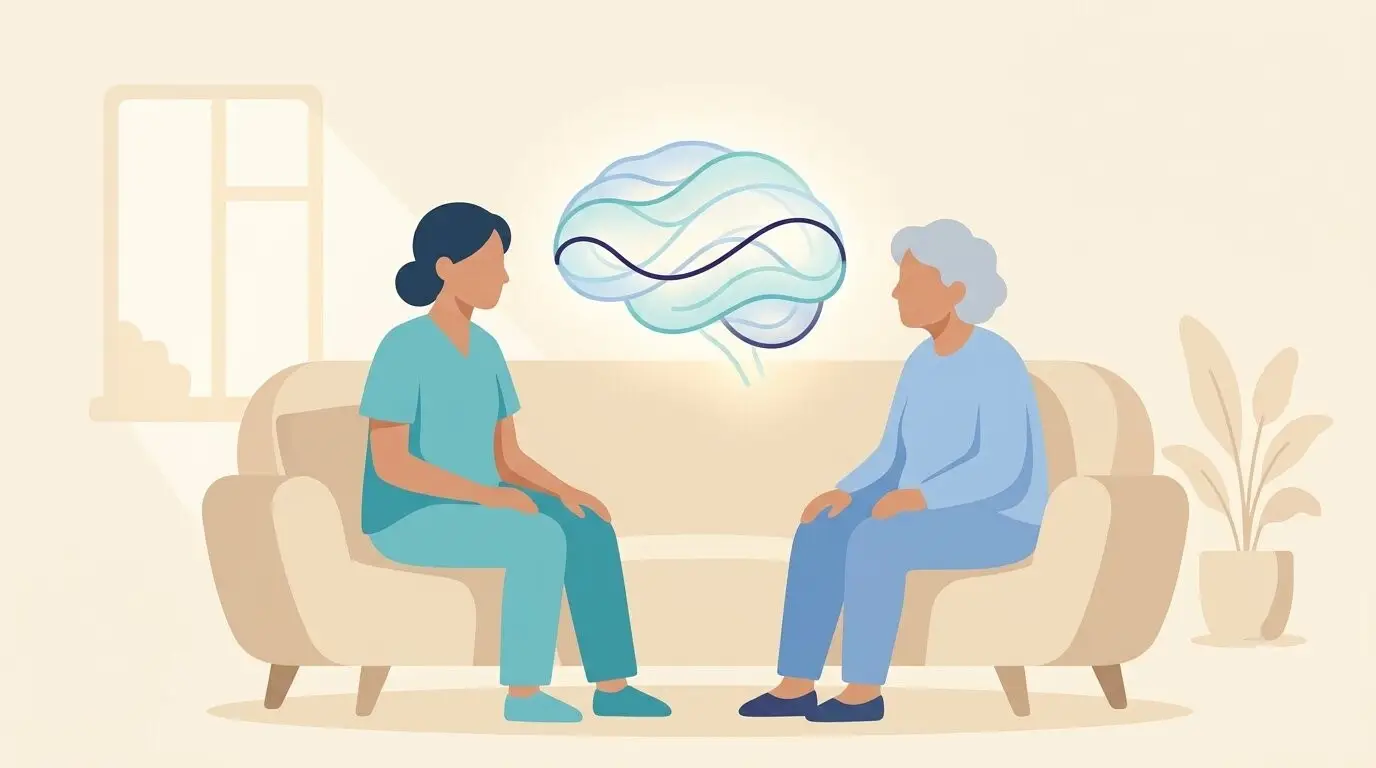
Care Certificate Standard 9 is the standard about awareness, and it is the one most likely to change how you behave on a shift where nothing visibly appears to be wrong. It covers what mental health and mental wellbeing mean, the common mental health conditions, what dementia is, and how any of it can change what a person needs from you. It then covers the three things that follow from understanding: positive attitudes and the social model of disability, the reasonable adjustments you can make, and early detection. It closes with the legal frameworks that sit underneath all of it.
Standard 9 is one of the sixteen standards in the Care Certificate, and it runs to five outcomes, level with Duty of care. What makes it feel long is the number of small, precise judgements it asks you to make, each one attached to a criterion you can be asked about.
The standards themselves are published by Skills for Care, Skills for Health, NHS England and the Department of Health and Social Care, and they were updated in March 2025. You can read the Care Certificate standards on the Skills for Care website, open the standards document itself, or read the Summary of changes published alongside it. Standard 9 is one of the standards that changed most in that update, so the summary is worth reading before you start. Every definition quoted on this page is a glossary definition taken from the standards document, and the outcome codes are the codes from that document.
What This Course Covers
The five outcomes run in a deliberate order. Outcome 9.1 is the understanding outcome: what mental health and mental wellbeing mean, the common mental health conditions, what dementia is, how these conditions influence a person’s needs, and why the causes and support needs are different for different people. Outcome 9.2 turns that understanding into how you behave, through positive attitudes and the social model of disability. Outcome 9.3 is the practical one: reasonable adjustments, planned in advance, and reporting unmet needs. Outcome 9.4 is about early detection, response and signposting. Outcome 9.5 is the legal framework, and it asks how the law shows up in an ordinary day.
The content follows those five outcomes exactly as they are written, so the course can be mapped to an induction checklist or an evidence folder without editing. The other standards sit in the same healthcare foundation course range. The standard before this one is Fluids and Nutrition, Care Certificate Standard 8, and the one after it is Adult Safeguarding, Care Certificate Standard 10. Every Care Certificate course we run is listed together in the full course list.
Who It’s For
This course is written for the non-regulated workforce, which is the term the standards document uses for the people the Care Certificate was designed for. It names the roles in each setting, and in health roles these include assistant practitioner, care assistant, healthcare support worker, maternity support worker, nursing assistant, occupational therapy assistant, physiotherapy assistant, radiography assistant, speech and language therapy assistant, and senior care assistant. In adult social care they include activities worker, day care assistant, day care officer, domiciliary care worker, home care worker, nursing assistant in a nursing home or hospice, personal assistants, reablement assistant, residential care worker, senior home care worker, and support worker. If you are starting or progressing in one of those roles in health or social care, this course is written for you.
If you are a registered professional, such as a doctor, nurse, social worker or occupational therapist, the standards document is explicit that you gain similar skills and knowledge within your professional training, so you do not need to also achieve the Care Certificate. Some employers still ask registered staff to complete it during induction, so check what your own employer expects before you assume it does not apply to you.
The glossary describes key people as “the people who are important to an individual and who can make a difference to his or her wellbeing”, and they “may include loved ones, family, friends, carers and others with whom the individual has a supportive relationship”. That matters for this standard more than for most, because the people who notice a change early are usually the people close to the person, and the standard asks you to work with them rather than around them.
Mental Health, Common Conditions and Dementia
Outcome 9.1 asks you to understand the needs and experiences of people with mental health conditions or dementia, and it carries five criteria. Criterion 9.1a asks you to describe what is meant by the terms mental health and mental wellbeing. Criterion 9.1b asks you to list common types of mental health conditions. Criterion 9.1c asks you to explain what is meant by the term dementia. Criterion 9.1d asks you to explain how these conditions may influence a person’s needs in relation to the care that they may require. And criterion 9.1e asks you to explain why it is important to understand that the causes and support needs are different for people with mental health conditions or dementia.
All three of the criteria at 9.1a, 9.1b and 9.1c were added in the 2025 update, and each one is anchored in the glossary. For 9.1b, the glossary says that psychosis, depression and anxiety should be covered as a minimum. For 9.1c, the glossary tells you what your explanation of dementia has to contain: it “should include key facts, causes and the different types of dementia, also that dementia will be different for every person”.
That last clause is the one to hold on to, because it is the point of the whole standard. Dementia will be different for every person. It is not a single condition with a checklist attached, and it does not look the same in two people carrying the same diagnosis.
Criterion 9.1d is where awareness becomes care. Needs are assessed, and the glossary is clear that assessed needs “can include a variety of physical, mental health, emotional, social, spiritual, communication, learning, support or care needs”. A mental health condition changes which of those needs are present and which have to be prioritised, and the change is often not in the person but in the support around them.
Criterion 9.1e is the sharpest sentence in the standard: it is important to understand that the causes and support needs are different for people with mental health conditions or dementia. Two people can carry the same label and need completely different things, and a worker who treats the label as the plan will get it wrong for one of them.
Positive Attitudes and the Social Model of Disability
Outcome 9.2 asks you to understand the importance of promoting positive health and wellbeing for an individual who may have a mental health condition or dementia, and it has two criteria. Criterion 9.2a asks you to explain how positive attitudes towards those with mental health conditions or dementia will improve the care and support they receive. Criterion 9.2b asks you to describe the social model of disability and how it underpins positive attitudes and involving people in their own care.
The social model of disability holds that a disability is produced by the interaction between an impairment and the barriers a society puts in the way, rather than by the impairment alone. Its practical consequence for your working day is direct. If the barrier is the building, the staffing, the noise, the rule about visiting hours, or the fact that nobody has asked this person what they need, then the fix belongs in the barrier.
Criterion 9.2a is the one that gets read as a platitude, and it is not. Positive attitudes towards people with mental health conditions or dementia improve the care and support they receive, because care is delivered by people, and how a person is spoken about in a corridor shows up in how they are spoken to at the bedside.
Wellbeing is what the outcome names, and the glossary widens it well beyond feeling fine. Wellbeing “considers health, happiness and comfort”, and it “may include aspects of social, emotional, cultural, mental, intellectual, economic, physical and spiritual wellbeing”. That is why this outcome sits alongside the social model rather than instead of it.
Reasonable Adjustments and Unmet Needs
Outcome 9.3 asks you to understand the reasonable adjustments which may be necessary in care delivery relating to an individual who may have a mental health condition or dementia, and it has two criteria. Criterion 9.3a asks you to identify reasonable adjustments which can be made in health and care services accessed by individuals living with a mental health condition or dementia, and the importance of planning these in advance. Criterion 9.3b asks you to describe how to report concerns associated with any unmet needs which may arise from mental health conditions or dementia through agreed ways of working.
The glossary defines reasonable adjustments as “steps, adaptions and changes which can be made to meet the needs and preference of an individual”. Two parts of that definition carry the weight. Steps, adaptions and changes: small, concrete, done. Needs and preference: singular, and specific to a person rather than to a diagnosis.
Criterion 9.3a also asks about planning these in advance, and that is the part that is often missed. An adjustment made on the day, in a rush, after something has already gone wrong, is a reaction. An adjustment planned in advance, before the appointment, the visit or the shift, is what the criterion is asking for.
Criterion 9.3b is the reporting criterion, and it specifies the route: through agreed ways of working. The glossary is useful on what those are, because agreed ways of working include “those less formally documented by individual employers and the self-employed or formal policies”. An unmet need is not something you resolve alone at the end of a shift, and where you take it depends on how your team has agreed to take it.
Early Detection, Response and Signposting
Outcome 9.4 asks you to understand the importance of early detection of mental health conditions or dementia, and it is the longest outcome in the standard, with five criteria. Criterion 9.4a asks you to describe how to recognise early indicators of mental health deterioration. Criterion 9.4b asks you to list early signs and symptoms of dementia. Criterion 9.4c asks you to explain why early detection of mental health needs or dementia is important. Criterion 9.4d asks you to give examples of how and why adjustments to care and support might need to be made when a mental health condition or dementia is identified or there is a decline in the individual’s condition. And criterion 9.4e asks you to explain ways to engage with and signpost individuals living with a mental health condition or dementia and their families and carers to other services and support.
All five of these criteria were added in the 2025 update, which tells you how much this outcome has changed. Recognition used to be a single line. It is now five criteria, and the last of them is about what you do next.
Criterion 9.4c is the reason to do it at all. Early detection matters because the alternative is a person who has deteriorated before anybody noticed, and because support that arrives late is support the person has to start from a worse starting point.
Criterion 9.4d is where detection becomes action. If a mental health condition or dementia is identified, or there is a decline in the individual’s condition, adjustments to care and support might need to be made, and the standard asks you to give examples of how and why. Read the word carefully: might. A decline does not automatically mean a different care plan. It means you check, and you adjust what needs adjusting.
Criterion 9.4e is the signposting criterion, and the one people are least sure about, because signposting is a skill of its own. Engaging with a person and their families and carers, and pointing them to other services and support, is not the same as telling them a telephone number. Advice and support “can come from within or outside of your organisation”, and key people may include loved ones, family, friends, carers and others with whom the individual has a supportive relationship. Often the person who needs to hear about a service is the family member, and the person who needs the support is the individual.
Legal Frameworks, Policy and Guidelines
Outcome 9.5 asks you to understand legal frameworks, policy and guidelines relating to mental health conditions or dementia, and it has two criteria. Criterion 9.5a asks you to list the main requirements of legislation and policies that are designed to promote the human rights, inclusion, equal life chances and citizenship of individuals with mental health conditions or dementia. Criterion 9.5b asks you to explain how the legislation and policies listed may affect the day-to-day experiences of individuals with mental health needs or dementia and their families.
The glossary is where the legislation is named. Legislation is “important legislation, which relates to topic content e.g., The Equality Act, The Human Rights Act, The Data Protection Act, and The Mental Capacity Act”. Those four are the standard’s own examples, and they map onto the four things criterion 9.5a asks about. Human rights sits in The Human Rights Act 1998, where human rights are “moral principles or norms for certain standards of human behaviour” that are “regularly protected in law”. Inclusion is “ensuring that all people are included, respected and appreciated as part of society”. Equal life chances is equality, “being equal in status, rights, and opportunities”, with protected characteristics “as defined by The Equality Act 2010”. And citizenship, and the individual’s own information, is where data protection sits.
Criterion 9.5b is the one that stops this outcome being a list. It asks you to explain how the legislation and policies may affect the day-to-day experiences of individuals with mental health needs or dementia and their families. The law is not decoration on the care plan. It changes how an appointment is arranged, how information is shared, how a decision is made, and how a person is spoken about. That is the same point the social model of disability makes, arrived at from a different direction.
What You’ll Learn
Across 6 structured lessons, this course covers:
- What mental health, common conditions and dementia are (outcome 9.1). Describe what is meant by the terms mental health and mental wellbeing, list common types of mental health conditions, and explain what is meant by the term dementia.
- How these conditions affect individual care needs (outcome 9.1). Explain how mental health conditions or dementia may influence a person’s needs in relation to the care that they may require, and explain why the causes and support needs are different for people with mental health conditions or dementia.
- Promoting positive attitudes and the social model of disability (outcome 9.2). Explain how positive attitudes towards those with mental health conditions or dementia improve the care and support they receive, and describe the social model of disability and how it underpins positive attitudes and involving people in their own care.
- Reasonable adjustments and reporting unmet needs (outcome 9.3). Identify reasonable adjustments which can be made in health and care services accessed by individuals living with a mental health condition or dementia and the importance of planning these in advance, and describe how to report concerns associated with any unmet needs through agreed ways of working.
- Early detection, responding and signposting (outcome 9.4). Describe how to recognise early indicators of mental health deterioration, list early signs and symptoms of dementia, explain why early detection is important, give examples of how and why adjustments to care and support might need to be made, and explain ways to engage with and signpost individuals and their families and carers to other services and support.
- Legal frameworks and their impact on daily experience (outcome 9.5). List the main requirements of legislation and policies designed to promote the human rights, inclusion, equal life chances and citizenship of individuals with mental health conditions or dementia, and explain how the legislation and policies listed may affect day-to-day experiences.
Duration & Format
- Estimated time: 1.5 CPD hours
- Format: Fully online and self-paced: start, pause and return at any time
- Device: Desktop, tablet, or mobile
- Assessment: Knowledge-check quizzes throughout, plus a final assessment
Certification
On successful completion you receive a downloadable certificate confirming your achievement. It is mapped to Care Certificate Standard 9, and it counts for 1.5 CPD hours towards your continuing professional development record.
Common Questions
How long do I have to complete this course?
There is no deadline. The course is self-paced, so you can begin whenever you are ready, stop part way through, and pick it up again later from any device. If your employer is mapping this against an induction checklist, the outcome codes 9.1 to 9.5 used on this page are the ones you will be assessed against.
Do I get a certificate?
Yes. Once you complete the course successfully, a downloadable certificate is issued to you, mapped to Care Certificate Standard 9 and worth 1.5 CPD hours towards your record.
What does the standard mean by mental health and mental wellbeing?
Criterion 9.1a asks you to describe what is meant by the terms mental health and mental wellbeing, and it was added to the standard in the 2025 update. The standards glossary defines wellbeing as something that “considers health, happiness and comfort” and that “may include aspects of social, emotional, cultural, mental, intellectual, economic, physical and spiritual wellbeing”. It does not give a separate definition of mental health or of mental wellbeing as terms in their own right, so what you write for those comes from your training provider. What the Care Certificate fixes is the framework around them: that you can describe them, that you know the common types of mental health conditions, and that you understand why a shared label does not mean a shared set of needs.
What is the social model of disability?
It is the framework that criterion 9.2b asks you to describe. It holds that a disability arises from the interaction between an impairment and the barriers society puts in the way, rather than from the impairment alone. The practical test it gives you is simple: when a person cannot do something they would like to do, ask what the barrier is. If it is a staircase, a noise, a rule about visiting, a fixed routine or an assumption, then the adjustment belongs with the barrier and not with the person.
Is this awareness training or specialist training?
Awareness, and the standard’s own title says so: Standard 9 is Awareness of mental health and dementia. The Care Certificate as a whole is introductory. The standards document says they are “designed with the non-regulated workforce in mind” and give workers “the same introductory skills, knowledge and behaviours to provide compassionate, safe and high-quality care and support”. If your role involves providing specialist mental health or dementia support, that sits on top of this standard rather than inside it, and it is arranged by your employer.
Is this course accredited?
This is a CPD-accredited course aligned to the Care Certificate framework published by Skills for Care, Skills for Health, NHS England and the Department of Health and Social Care, updated 2025.
Which version of the standards does this cover?
The 2025 update, and this standard changed more than most in it. The title changed: the standard used to be Awareness of mental health, dementia and learning disabilities, and learning disability and autism are now covered by Standard 16, Awareness of learning disability and autism. The content that used to sit at learning outcome 9.6, on mental capacity, moved to Standard 5, Work in a person-centred way. Within the standard, criteria were added to learning outcome 9.1 on what mental health and mental wellbeing mean, on common types of mental health conditions and on what dementia means, to 9.3 on reasonable adjustments and planning them in advance, and to 9.4 on recognising early indicators of mental health deterioration, on early signs and symptoms of dementia, and on engaging with and signposting to other services and support. Skills for Care recommends a thorough review of this standard so that all of the updated and replaced criteria are captured. This course follows the current version, and the outcome codes on this page are the codes from that document.
Care Pro Academy · Registered in the UK · Mundells, Welwyn Garden City, Hertfordshire AL7 1FT

Reviews
There are no reviews yet.